
There’s Something in the Air

By Mary Budinger / April 23, 2026
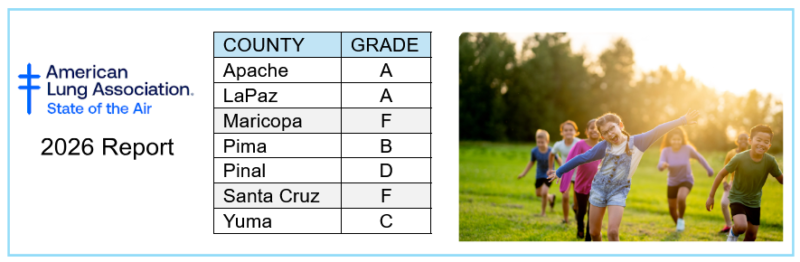
The American Lung Association just released their annual air quality ratings; they give the counties of Maricopa and Santa Cruz a grade of “F” for particle pollution. And nation-wide, Phoenix ranks as the 15th worst city in the U.S. for year-round particle pollution; Phoenix/Mesa ranks 4th worst year-round for ozone.
Particles in air pollution can be smaller than 1/30th the diameter of a human hair. When you inhale them, they are small enough to get past the body’s natural defenses. Particle pollution can cause early death and heart attacks, strokes and emergency room visits. Ozone and particle pollution are both linked to increased risk of premature birth and lower birth weight in newborns.
Infants, children, and teens as a group are more susceptible to the health impacts of air pollution because their lungs are still developing, they breathe more air for their body size than adults, and they are frequently exposed to outdoor air.
A key overall finding of the report is that nearly half of American children live in places with unhealthy levels of air pollution.
The American Lung Association credits the Clean Air Act for decades of improvements in air quality. “This landmark law has successfully driven pollution reduction for over 55 years.” But the Environmental Protection Agency (EPA) is rolling back clean air protections, and has eliminated health costs from its economic analysis. Both actions threaten clean air progress.
RESOURCE: Read the full report HERE.
ACTION ITEM: Sign the petition HERE to “tell the EPA to return to its mission and make kids’ health count.”
Mary Budinger is an Emmy award-winning journalist and a certified nutritional therapist (NTP). She lives in Phoenix and writes about functional medicine and nutrition.
The views and opinions expressed in this article are those of the author(s) and do not necessarily reflect the views of Children’s Health Defense and/or Children’s Health Defense – Arizona. Information shared and presented is for educational purposes only; no material is intended to be a substitute for professional medical advice, diagnosis, treatment or any other professional advice.