
Aaron Siri in Phoenix Armed with Vaccine Facts
 By Mary Budinger / May 29, 2026
Attorney Aaron Siri, best known for suing government agencies over misrepresentations of vaccine science, spoke May 20th before a sold-out room in Phoenix. He did not disappoint.
“We are seeing a change where the average legislator today has a deeper understanding of health freedom issues,” he said. “It used to be, we couldn’t even get in the room to talk. Now legislators around the country call me for help with health freedom bills.”
Siri is a big part of that change. He has pursued nearly 150 lawsuits on behalf of Informed Consent Action Network, Del Bigtree’s organization that probes the scientific realities about vaccines’ safety and effectiveness. He has challenged medical mandates, prevented the discharge of more than 10,000 U.S. military personnel, compelled the FDA to release Pfizer’s Covid-19 documents, and deposed leading vaccinologists. 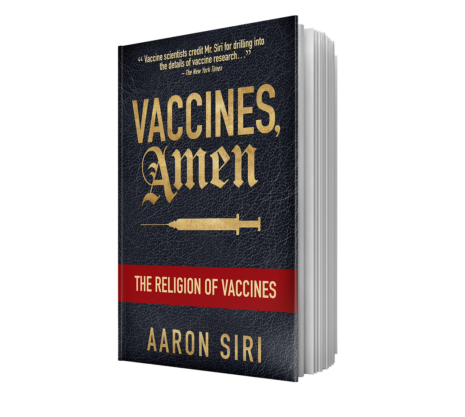
He is the managing partner of Siri & Glimstad LLP, the author of the book Vaccines, Amen: The Religion of Vaccines, and hosts the podcast Informed with Aaron Siri.
“Vaccine manufacturers should persuade people on the merits of their products,” he said. “These products should be subject to normal market forces, but they are not.”
Siri was referring to the National Childhood Vaccine Injury Act of 1986. At that time, there were just three vaccines on the market and they were doing so much harm, there was a virtual conveyor belt of lawsuits from parents of injured children. The insurance industry was going to stop covering the manufacturers. So Congress granted a liability shield for those who make vaccines and those who administer them. Safety responsibility transferred at that point to the government.
The law created a one-of-a-kind business model at a time when perhaps just 60 percent of school children were fully vaccinated. Vaccine manufacturers suddenly had nothing to lose; the pediatric schedule expanded.
And the drumbeat got louder – advocating for vaccines became something of a religion among those who profit from them professionally and financially, including lawmaker’s re-election campaigns. “Safe and effective” became an endlessly repeated mantra, but not one validated by in-depth, objective studies. Notably, the 1986 legislation admitted that vaccines are “unavoidably unsafe.” Nonetheless, vaccine uptake today is in excess of 90 percent for most recommended vaccines among American children entering kindergarten.
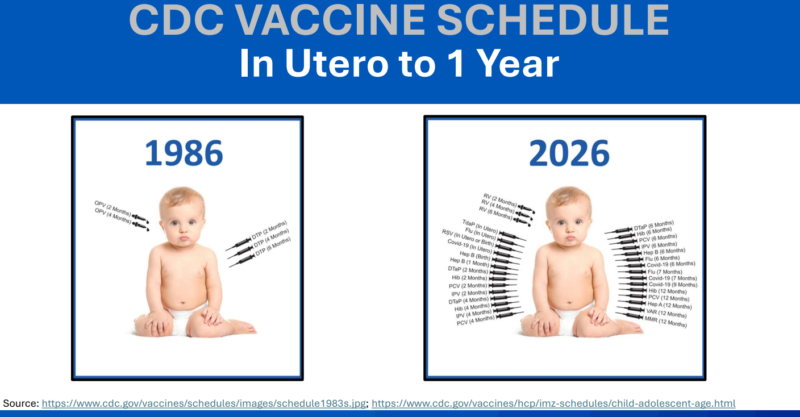
The 2025 CDC pediatric schedule calls for roughly 74 vaccines from birth to age 18. There is a concentration of shots in the first year, and a number of those use an aluminum adjuvant. Various researchers have postulated that those two factors may underlie the epidemics of autism and chronic disease and should be studied.
Siri walked the audience through each vaccine on the CDC’s childhood schedule. Some block transmission; some don’t. Some, like chickenpox and measles, shed – other people who come in contact with a newly vaccinated person can catch the virus. Some are cultured in aborted fetal cells. None offers lifelong immunity. None has ever been tested against a saline placebo.

Most vaccine studies were small groups of participants who were followed for a matter of days, not years. For example, the Hepatitis B (Hep B) injection was tested on 147 children who were as much as 10 years old – a very different immune system than that of a newborn infant. And those 147 children were followed for just five days. Based on that, public health officials advocate giving the Hep B injection to all of the roughly 3.5 million babies born each year in the U.S.
“This makes mandates illegal and immoral.”
Siri pointed out that the rates of fatalities from childhood illness had declined dramatically since the 1940s compared to the early 1900s. Vaccines mostly entered the picture after WWII at which point childhood fatalities had declined 95 percent. “For some reason, public health officials never take credit for the better sanitation and cleaner water systems that made that happen,” he said. “It’s the oddest thing.”
Siri also pointed out that every study of vaccinated versus unvaccinated children has found that the unvaccinated are measurably healthier. They have less autism, asthma, allergies, ADHD, autoimmune conditions, behavioral and mood disorders.
Adults born before vaccines were so prevalent – those who caught the natural infections – are also healthier. A Japanese study, for example, tracked 100,000 adults for 20 years. Turns out those who had actually experienced measles and mumps had less cardiovascular disease. Men had a 29 percent lower risk of myocardial infarction mortality, and a 17 percent lower risk of stroke.
The evidence suggests that childhood illnesses are nature’s way of training and strengthening the young immune system to make a more robust adult.
“On these products, you have to do your homework,” Siri concluded. “All the people with moneyed interests are pushing in one direction. There are no other moneyed interests pushing back in the opposite direction.” Health versus money, a familiar battleground.
The silver lining for consumers comes in having choices. “In Arizona, you have many naturopaths and functional medicine doctors. You have options to the big pediatric practices that push the entire CDC schedule blindly.”
The event was put together by the Brownstone Supper Club, an initiative of the Brownstone Institute, a nonprofit think tank founded in May 2021 by Jeffrey Tucker and Lucio Saverio Eastman, headquartered in Austin, Texas, and focused on health freedom.
Mary Budinger is an Emmy award-winning journalist and a certified nutritional therapist practitioner (NTP). She lives in Phoenix, AZ, and writes about functional medicine and nutrition.
Disclaimer: The views and opinions expressed in this article are those of the author(s) and do not necessarily reflect the views of Children’s Health Defense and/or Children’s Health Defense – Arizona. Information shared, presented, and/or hyperlinked is for educational purposes only; no material is intended to be a substitute for professional medical advice, diagnosis, treatment or any other professional advice.